THIS ART IS LONG GONE
Ephemeral Art at The White Cottage - Documenting Lost Street Art at Killiney Beach (March 2008)
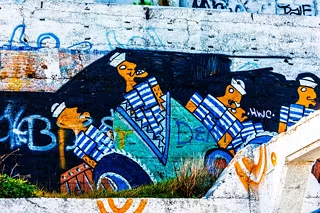
In March 2008, while photographing along the northern end of Killiney Strand just beneath the railway line and footbridge, I came across a remarkable series of murals painted across the weathered walls and concrete pillars of the old derelict tearooms. At the time, the building stood vacant and exposed to the coastal elements; in the years since, following remedial works and partial demolition, those artworks have vanished entirely.
Even in 2008, the style of the work stood out as highly unusual for Ireland. While Dublin's street art scene during that decade was largely defined by traditional New York-influenced wildstyle lettering, throw-ups, and early stencil work, the pieces at Killiney belonged to a very different visual tradition—one rooted in the European "post-graffiti" and character-driven illustration movement then flourishing across cities in France, Spain, and Germany.
History of the Killiney Beach Tearooms ("The White Cottage")
Known locally as The White Cottage or Homan’s Tea Rooms, the complex sits at the northern edge of Killiney Strand, a stretch of coastline documented as a bathing spot since at least John Rocque’s 1760 map. From the mid-nineteenth century onward—appearing in local newspaper notices as early as 1854—the beach enterprise became synonymous with the Homan family.
Nineteenth-Century Roots: Local fisherman Richard Homan and his German-born wife, Mary Helena Jahraus, lived at The White Cottage from the late nineteenth century, with Mary Helena residing there until her death in 1943 at the age of 91.
Dance Pavilion, Chalets & Boat Hire: In 1923, the family laid an outdoor dance floor alongside the cottage. From the 1920s through to the early 1960s, the whitewashed seaside complex—which architectural historian Peter Pearson famously remarked looked more reminiscent of Greece than Victorian Dublin—operated as a bustling tearoom, dance pavilion hosting regular dances for groups such as the De Vesci Lawn Tennis Club, bathing-box changing facility, and rowing-boat hire station. It was run by the Homan brothers (Fred, Art, and Jimmy) and later by Fred and Nancy Homan.
Dereliction & Modern Revival: After decades of disuse, the empty whitewashed walls and octagonal concrete piers became a secluded, unpoliced canvas for street artists. In 2003, Irish visual artist Tracy Staunton even installed an interior screen-printed piece inside the derelict tearooms as part of her site-specific project 10 Dreams in Dublin. By May 2014, Dún Laoghaire-Rathdown County Council engaged with the property’s owners regarding the condition of the graffiti-covered building, resulting in clean-up and structural stabilisation works that erased the murals. Today, the historic address has found new life through Fred & Nancy's, a mobile Airstream café named in honour of Fred and Nancy Homan, operating directly at the site alongside a coastal sauna.
A Rare Example of European Post-Graffiti Character Art in Ireland
Looking closely at the photographs from March 2008, the artists clearly approached the derelict tearooms not as a spot for quick tags, but as an unhurried, multi-panel installation. Rather than relying on aerosol fades or calligraphic lettering, the works combine bold black outlines, flat colour blocking, and intricate pattern fills—such as blue polka dots, cross-in-square geometric medallions, and flowing botanical tendrils.
Several distinct motifs and visual clues point toward either visiting continental European artists or local illustrators deeply immersed in French and German urban art collectives:
Totemic & Neo-Primitivist Figures: Wrapped around the octagonal concrete support pillar is a vertical chain of stacked, climbing figures rendered in warm ochre and black outlines, set against deep blue water motifs and geometric cross patterns.
Surrealist & Organic Forms: Across the rendered brick recesses, a bowler-hatted silhouette stands against a field of blue polka dots beside coiled, coral- or brain-like organic forms and flowing blue tendrils.
Cartoon & Cubist Characters: Elsewhere on the walls appear playful, vinyl-toy-inspired characters—including a wide-eyed, fanged creature beside an abstract geometric block inscribed with "SNC?", a headphone-wearing DJ figure with "DRUM" painted across his green shirt, a yellow character bearing the German word "Junge..." ("boy" or "young"), and angular, cubist-inspired sailors dressed in blue-and-white Breton stripes next to the letters "DE...".
Because The White Cottage sat tucked below the railway embankment away from street-level foot traffic, its quiet dereliction gave these artists the time and privacy to execute complex, illustrative murals rarely seen on Irish walls in 2008. Although the paint has long since been stripped back and the structure altered, this March 2008 sequence preserves a brief, colourful chapter in the long coastal history of Killiney Strand.

KILLINEY STREET ART