I DID NOT PUBLISH THIS UNTIL HALLOWEEN 2026
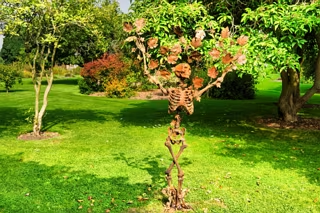
TREE OF LIFE BY BRIAN BYRNE AT SCULPTURE IN CONTEXT PUBLISHED SPECIALLY FOR HALLOWEEN 2026
Back in 2014 I was using a Sony NEX-7 and was at the beginning of my migration from Canon DSLR to Sony mirrorless. Walking through the annual Sculpture in Context exhibition on the grounds of the National Botanic Gardens in Glasnevin, I encountered a work that arrested me immediately: Brian Byrne’s Tree Of Life.
Constructed from welded and forged mild steel, Byrne’s piece presents an uncanny, macabre dialogue between human anatomy and botanical growth. A rusted skeleton rises from the manicured turf, its lower limbs planted like a trunk, while its arms and spine stretch upward into the spreading boughs and foliate canopy of a grapevine. The weathered patina of the metal gives the bones the tactile, fibrous texture of aged bark. Rather than a bleak memento mori, the sculpture operates as an allegory of natural cycles—death nourishing life, rooted in decay and reaching toward the canopy. The biblical resonance of its title suggests both the forbidden pursuit of mortality and the literal harvest itself, making it an extraordinary visual touchstone for the turning of the year.
In the official Sculpture in Context records (specifically confirmed in the 2015 catalogue, which lists the previous year's award winners), the piece won the Public Choice Award for Most Popular Sculpture in 2014 under the title:
"The awards for the Most Popular Sculptures voted by the public, were won by Brian Byrne for 'Tree of life' and Hannah Kavanagh for 'Jack and the Beanstalk'."
I notice that some accounts referred to this sculpture as "The Tree Of Knowledge"
The confusion with "Tree of Knowledge" is common because:
Biblical/Botanical Conflation: The biblical narrative in Genesis places the Tree of Life and the Tree of Knowledge of Good and Evil side by side in the Garden of Eden. Because the sculpture incorporates a skeletal figure with foliate branches, viewers and art bloggers (as well as visitors documenting the 2014 exhibition) frequently misremembered or transcribed it as Tree of Knowledge.
The Allegorical Theme: With the skeleton representing mortality and the vine representing life, Tree of Life was Byrne's intentional title—framing the figure not around the fall of humanity, but as a direct embodiment of the life cycle.
The Evolution of Halloween: Samhain, Export, and Return
The festival belongs originally and indisputably to the ancient Gaelic pastoral calendar. Known as Samhain—marking "summer’s end"—it heralded the close of the harvest and the onset of the dark half of the year. To our Gaelic ancestors, this liminal interval represented a collapse of barriers: the veil separating our mundane world from the Otherworld (Aos Sí) wore dangerously thin. Sacred bonfires were kindled, cattle were driven between flames for purification, and large turnip lanterns were hollowed out with menacing visages to ward off mischievous wandering spirits.
Following Christianisation, the medieval Church placed its own theological frame over the existing seasonal rhythm. In the ninth century, November the first was established as All Saints’ Day (All Hallows), followed on November the second by All Souls’ Day, reserving October the thirty-first as All Hallows’ Eve—the origin of the name Halloween. Domestic traditions blossomed: barmbrack baked with symbolic tokens of prophecy (the ring, the pea, the rag), apple-bobbing, and masked "guisers" going door-to-door in exchange for food.
During the mid-nineteenth century, the mass emigration driven by the Great Famine transplanted these communal folk customs into the cities and suburbs of North America. There, the festival underwent an industrialised metamorphosis. The tough native turnip was quickly discarded for the indigenous, pliable pumpkin. Guising became modern trick-or-treating, propelled by retail confectioners, plastic costumes, and Hollywood horror imagery. By the mid-twentieth century, Halloween had transformed into a commercialised export, marketed globally with such vigour that much of the world now erroneously assumes it to be a homegrown American holiday.
When that Americanised format drifted back across the Atlantic in recent decades, it did not extinguish the Irish character; it formed a peculiar hybrid. Today, Ireland marks the season under unique circumstances:
The Bank Holiday Framework: Unlike Britain or the United States, the Republic anchors the season with a statutory public holiday on the final Monday of October, providing a distinct long weekend that accommodates street carnivals, community parades, and family travel.
The Liturgical Horizon: Beneath the plastic masks, the original religious observances endure. Attending church services for All Saints and walking cemetery paths to tend ancestral plots on All Souls remain widely observed domestic practices.
The Firework Phenomenon: While the United Kingdom reserves its autumn fireworks almost exclusively for Guy Fawkes Night on the fifth of November, in Ireland the pyrotechnics belong wholly to Halloween. Despite being entirely illegal without a Department of Justice licence, private fireworks and neighbourhood bonfires have long formed a chaotic soundtrack across Dublin throughout October.
The Lost Greeting: From "Holy Eve" to Commercial Cheer
To ears accustomed to an older Ireland, wishing someone a breezy "Happy Halloween" carries a distinctly unnatural ring. Growing up, the phrase was simply absent from our daily vernacular.
The occasion was never conceived as an upbeat event demanding universal jollity. In mid-twentieth-century Ireland, the thirty-first of October was referred to either simply as "Halloween Night" or by its older title, "Holy Eve." It was an evening marked by suspense, domestic mischief, and a touch of genuine foreboding.
Conversations did not revolve around cheerful holiday wishes; instead, older neighbours parted with a practical, cautionary admonition: "Mind yourself tonight."
That reticence was rooted in the calendar itself. The evening served strictly as the threshold to two solemn, non-commercial liturgical observances: All Saints’ Day on the first of November, followed immediately by All Souls’ Day on the second. These were days of obligation, quiet prayer, and family visits to the cemetery. Framing the eve of those reflective days with generic commercial cheer would have struck older generations as incongruous.
While the Irish language preserved its own formal marker in Oíche Shamhna Shona Duit, the modern impulse to greet acquaintances with "Happy Halloween" only crossed the Atlantic in recent decades. It arrived as part of the broader retail package—tucked between imported decorations and mass marketing. Leaving the phrase unspoken is not an oversight; it is an instinctual adherence to the authentic temper of an Irish autumn, where the night was meant to be treated with caution, not trivialised.
A Step Function in the City: The Uncanny Quiet of 2026
For those living in the historic core of Dublin, the final week of October has historically meant locking the front door, battening down the hatches, and preparing for the inevitable fallout of rogue bonfires, screaming fireworks, and property risk.
Yet this year has delivered a genuine step function: an unprecedented, twenty-four-hour calm. The familiar signs of mid-autumn youth culture—the dragging of stolen shipping pallets through cobbled lanes, the rattles of shopping trolleys loaded with timber, and the concussive daylight explosions echoing off Georgian brickwork—have simply failed to materialise.
The sudden collapse of this ritual stems from several converging factors:
Intensified Interceptions: The primary pipeline of illicit fireworks—traditionally run down the M1 corridor from Northern Ireland by boot-dealers exploiting licensing disparities—has been systematically dismantled by coordinated Garda and PSNI checkpoints under Operation Tombola, alongside enhanced freight screening at postal sorting hubs.
The Squeeze on Mail-Order Imports: For years, informal sellers and curious youths sourced cheap parcels of pyrotechnics and novelty accessories directly from vendors outside the European Union. That pipeline has been priced out of existence. Customs duties on individual imported package lines, combined with An Post’s handling and clearance surcharge, mean that a nominal package costing pennies now incurs substantial fixed fees before it can be collected. With mandatory electronic data pre-clearing every parcel, anonymous mail drops are intercepted instantly at customs, turning small speculative orders into guaranteed financial liabilities and triggering immediate Garda scrutiny.
Pre-emptive Council Removals: Dublin City Council's public domain teams have operated with ruthless efficiency, tracking and confiscating timber caches within hours of their appearance, rendering days of scavenging futile.
The Lockdown of Timber Chains: Commercial businesses and fruit markets across the north inner city now heavily secure and account for returnable deposit pallets, closing off the surplus scrap that previously fuelled local street pyres.
Structured Municipal Alternatives: The deliberate funding of organised, non-destructive public events and family-friendly light displays has quietly severed the generational momentum of street-corner fires.
Finding the streets peaceful at all hours right up to the end of October marks a remarkable turning point for inner-city Dublin—leaving space to view the autumn light and reflective sculptures like Byrne’s without the customary siege atmosphere outside.
THE TREE OF LIFE