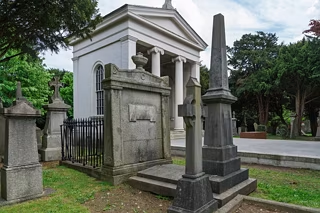
I USED A SONY A7RII TO PHOTOGRAPH GOLDENBRIDGE CEMETERY IN MAY 2017
BACK IN 2017 GOLDENBRIDGE CEMETERY WAS OPEN TO THE PUBLIC BUT SINCE THEN ACCESS HAS BEEN RESTRICTED
I used a Sony A7RII when I visited this historic cemetery in 2017 and I was lucky as there was a caretaker who allowed me to explore and photograph at will. I mention this because the cemetery was supposed to be open to the public but in reality this was not the case in May 2017.
Goldenbridge Cemetery in Inchicore holds a foundational place in modern Irish social and religious history. Established in the late 1820s, it represents both the dawn of non-denominational burial rights in Ireland and a preserved, garden-style oasis reflecting Victorian Dublin's political and civil struggles.
Origin and Political Catalyst
Prior to the 1820s, the Penal Laws and subsequent legal restrictions meant that Roman Catholics and dissenters possessed virtually no consecrated burial grounds of their own in Dublin. Deceased Catholics were predominantly interred in Protestant churchyards (such as St Kevin’s on Camden Row or St James’s), where Catholic clergy were prohibited by law from reciting funeral prayers or conducting graveside rites.
The spark for change occurred in September 1823 at St Kevin's Churchyard during the funeral of Arthur D’Arcy, a respected Catholic merchant. When Father Blake attempted to offer prayers for the dead, the Protestant sexton, acting on the strict instructions of William Magee, the Protestant Archbishop of Dublin, intervened and halted the prayers.
Outraged by this public indignity, Daniel O’Connell and the Catholic Association launched a major campaign. This directly spurred the British Parliament to pass the Easement of Burial Act of 1824 (Burials (Ireland) Act 1824). Following this reform, the Dublin Cemeteries Committee (the precursor to the Dublin Cemeteries Trust / Glasnevin Trust) was formed. In 1828, two acres of land were purchased alongside the Grand Canal at Goldenbridge in Inchicore for £600, officially opening for burials on 15 October 1829 as the first garden-style cemetery in Ireland welcoming people of all religious persuasions.
History and Historic Interments
Modelled on early European garden cemeteries, Goldenbridge featured gravel pathways, mature trees, and a central classical mortuary chapel, flanked by watchtowers and high perimeter walls designed to counter grave-robbing and body-snatching.
The cemetery filled at an astonishing pace. In 1832, the great cholera epidemic devastated Dublin, and thousands of victims were interred in mass communal graves at Goldenbridge within a matter of months. Due to this rapid saturation, O’Connell and the Committee recognised the urgent need for a much larger space, leading directly to the founding of Prospect Cemetery (Glasnevin) in 1832.
In 1869, a contentious dispute arose between the cemetery committee and the War Office over the proximity of burials to the adjacent Richmond Barracks. The authorities declared the site an alleged public health nuisance and issued an order prohibiting new burials, effectively closing Goldenbridge for general public interments after roughly 40 years of heavy use. Only families holding existing private vaults or reserved burial rights were permitted subsequent burials.
Notable Interments
W. T. Cosgrave (1880–1965): The first President of the Executive Council of the Irish Free State, who chose to be buried here in his family plot rather than receive a formal state burial at Glasnevin.
Father Michael Phelan: Renowned temperance advocate.
Eugene O'Reilly: Fenian leader.
Cholera and Famine Victims: Thousands of ordinary Dubliners interred during the catastrophic epidemics of the 1830s and 1840s.
Current Status, Vandalism, and Access
Vandalism Issues: Over the 2010s, Goldenbridge suffered repeated, severe spates of anti-social behaviour and wanton desecration. Between 2014 and 2016, dozens of 19th-century limestone headstones, Celtic crosses, and pre-Victorian memorials were toppled and smashed. Most notably, in both 2015 and early 2016, vandals deliberately desecrated and broke the headstone marking the W. T. Cosgrave family grave.
Restoration and Security: The Dublin Cemeteries Trust, in partnership with Dublin City Council and the Richmond Barracks heritage initiative, undertook extensive conservation work to repair broken headstones, reinforce boundaries, and install surveillance measures.
Controlled Access: To protect the fragile grounds from recurrent anti-social damage while still permitting public engagement, the perimeter gates are kept secured. Casual walk-in access is restricted; regular access is provided primarily via official guided walking tours organised in conjunction with Richmond Barracks and Dublin Cemeteries Trust, alongside pre-arranged access for descendants and bona fide researchers or archivists by appointment.
The Goldenbridge Luas Stop is located directly on the Grand Canal towpath (Drimnagh side), linked across the water to the cemetery boundary wall and Connolly Avenue by the modern footbridge. Geographically, it is the closest public transit point to the cemetery entrance, but it requires notable caveats for visitors.
Assessment of the Canal Section (Red Line)
1. Anti-Social Behaviour on the Canal Towpath & Stops
Canal Corridor Characteristics: The stretch of the Red Line running between Suir Road, Goldenbridge, and Drimnagh is positioned along an open, semi-isolated towpath bordering the Grand Canal. Unlike street-running sections, it lacks active street frontage and passive natural surveillance from passing vehicular traffic.
Youths on Bicycles & E-Bikes: This section is well known locally for groups of youths congregating at platforms and riding bicycles/e-bikes along the canal paths. Incidents frequently reported include erratic cycling across platforms, blocking tram doors, intimidation, open drug use, and verbal harassment.
The Footbridge: The pedestrian footbridge spanning the canal between the stop and Goldenbridge/Inchicore can occasionally function as a natural choke point or gathering spot for loitering, particularly during late afternoons, weekends, and after dark.
2. Conditions On Board the Red Line
Incidents & Disruption: The Red Line regularly experiences significantly higher rates of anti-social incident reports than the Green Line. Common complaints include open consumption of alcohol or substances, unruly behaviour, door-holding to delay trams, and loud confrontation.
Operator Interventions: Transdev (the Luas operator) and An Garda Síochána regularly conduct joint patrols and blitz operations, supported by on-tram CCTV and the passenger reporting system (the 51444 text / WhatsApp service). However, roving security guards cannot be on every service, meaning situations often occur unmonitored between stops.
Guidance & Recommendations for Visitors
If you are drafting notes or an advisory for visiting photographers, tourists, or heritage researchers, the following recommendations provide a practical, safety-conscious approach:
Timing Matters:
If arriving via the Luas at Goldenbridge, it is generally straightforward during busy daylight hours (mid-morning to early afternoon on standard weekdays).
Visitors should avoid using this stop at dusk, during dark winter evenings, or at quiet weekend periods when passenger numbers thin out and loitering increases.
Alternative: Main Road Bus Routes (Inchicore Road / Tyrconnell Road):
A widely recommended, more visible alternative is to take Dublin Bus routes serving Inchicore village (such as routes G1, G2, 60, or 13) along Tyrconnell Road / Emmet Road.
Alighting at Emmet Road or Richmond Barracks leaves a 5-to-8 minute walk along well-lit, active residential streets to the cemetery gates on St Vincent Street West, avoiding the canal bank and footbridge altogether.
Alternative Approach via Richmond Barracks:
Because public access to Goldenbridge Cemetery is primarily organised in conjunction with guided visits starting at Richmond Barracks, arriving directly at the Barracks via the main street network is both safer and logistically simpler.
General Safety Protocols:
Visitors carrying visible or expensive camera equipment should keep gear discretely stowed in ordinary bags until safely inside the secured cemetery grounds.
If travelling by tram, choosing the front carriage near the driver's cab is standard local practice when travelling through quieter stretches of the Red Line.
Update: The Tram Operator Has Changed
Transdev's 22-year tenure operating the Luas came to an end after Transport Infrastructure Ireland (TII) awarded the multi-billion-euro operation and maintenance contract to a new operator, KeolisAmey Luas, which officially took over operations on 1 September 2026.
tii.ie
The persistent struggle to contain anti-social behaviour, fare evasion, and staff/passenger safety issues—particularly across vulnerable open stretches of the Red Line like the Grand Canal corridor—formed a central part of the severe public and political criticism directed at the previous operating model:
Safety and Contract Scrutiny: Over recent years, TII, the National Transport Authority (NTA), transport trade unions (SIPTU), and commuter groups voiced escalating frustration over safety on the Red Line. Security interventions were widely seen as reactive rather than preventative, with roving private security personnel unable to curb rowdy gangs, open illicit activity, and intimidation at isolated stops.
The New Operating Regime: The tender process placed heightened emphasis on service quality, passenger security, and network resilience. Under KeolisAmey Luas, the operator faces stricter Key Performance Indicators (KPIs) tied to customer environment and safety standards, alongside closer coordination with An Garda Síochána's public transport policing initiatives.
Current Reality on the Ground: While the operating management transitioned in September 2026, the structural vulnerabilities of the canal stretch—such as open towpath access, absence of ticket barriers, and fast escape routes on e-bikes—remain an ongoing challenge.
For visitors planning a trip to Goldenbridge Cemetery, noting the management change and ongoing security focus is relevant, but the advisory caution regarding the canal towpath and footbridge remains practical advice.
GOLDENBRIDGE CEMETERY