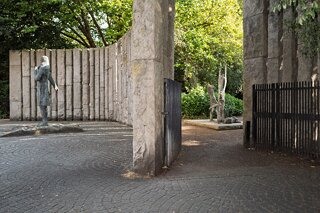
PUBLIC ART BY EDWARD DELANEY PHOTOGRAPHED 1 AUGUST 2026
WOLFE TONE SCULPTURE AND THE FAMINE MEMORIAL AT ST STEPHENS GREEN [BY EDWARD DELANEY]
Situated at the north-eastern corner of St Stephen’s Green in Dublin, two iconic public monuments share a single granite backdrop: the monumental statue of revolutionary leader Theobald Wolfe Tone—affectionately dubbed "Tonehenge" by locals—and the harrowing Famine Memorial. Both works were created by Edward Delaney RHA (1930–2009), one of Ireland’s most influential 20th-century modernist sculptors.
The Artist: Edward Delaney (1930–2009)
Born in Claremorris, County Mayo, Edward Delaney trained at the National College of Art and Design in Dublin before furthering his studies in Munich and Rome through Arts Council scholarships.
Delaney was instrumental in introducing modern expressionism and the ancient lost-wax bronze casting (cire perdue) technique to post-war Irish public art. Rather than fashioning pristine, idealized Victorian likenesses, his work is characterized by raw textures, elongated forms, and a deliberate, poignant awkwardness.
Among his most prominent commissions are the Thomas Davis statue in College Green (1967) and the twin installations at St Stephen’s Green.
The St Stephen’s Green Installations
Architect Noel Keating collaborated with Delaney to design the architectural arrangement for the north-east entrance. The dual layout creates an artistic dialogue between political idealism and human suffering.
1. The Wolfe Tone Memorial ("Tonehenge")
Unveiled: 1967 by President Éamon de Valera.
Design: A imposing 3-metre lost-wax bronze figure depicting Theobald Wolfe Tone (1763–1798), founder of the United Irishmen and widely recognized as the father of Irish republicanism.
The "Tonehenge" Monoliths: Tone stands in front of a curved semi-circle of large, roughly hewn granite slabs sourced from the Wicklow mountains. This megalithic structure earned the nickname "Tonehenge" from Dubliners.
Political Drama: In 1971, during the height of the Troubles, Loyalist paramilitaries bombed the statue, blowing it into fragments. Delaney gathered the bronze pieces and re-cast the entire sculpture.
2. The Famine Memorial
Erected: 1967 (companion piece).
Design: Located immediately behind the granite wall, facing into the interior of the park, this was Dublin's first civic memorial dedicated to the Great Famine (1845–1852).
Composition: Four bronze figures—emaciated, skeletal, and hollowed-out—depict a starving family accompanied by a dying dog at their feet. The expressive, rough-cast bronze emphasizes severe hunger, loss, and devastation.
Situated at the north-eastern corner of St Stephen’s Green in Dublin, two iconic public monuments share a single granite backdrop: the monumental statue of revolutionary leader Theobald Wolfe Tone—affectionately dubbed "Tonehenge" by locals—and the harrowing Famine Memorial. Both works were created by Edward Delaney RHA (1930–2009), one of Ireland’s most influential 20th-century modernist sculptors.
The Artist: Edward Delaney (1930–2009)
Born in Claremorris, County Mayo, Edward Delaney trained at the National College of Art and Design in Dublin before furthering his studies in Munich and Rome through Arts Council scholarships.
Delaney was instrumental in introducing modern expressionism and the ancient lost-wax bronze casting (cire perdue) technique to post-war Irish public art. Rather than fashioning pristine, idealized Victorian likenesses, his work is characterized by raw textures, elongated forms, and a deliberate, poignant awkwardness.
Among his most prominent commissions are the Thomas Davis statue in College Green (1967) and the twin installations at St Stephen’s Green.
The St Stephen’s Green Installations
Architect Noel Keating collaborated with Delaney to design the architectural arrangement for the north-east entrance. The dual layout creates an artistic dialogue between political idealism and human suffering.
1. The Wolfe Tone Memorial ("Tonehenge")
Unveiled: 1967 by President Éamon de Valera.
Design: A imposing 3-metre lost-wax bronze figure depicting Theobald Wolfe Tone (1763–1798), founder of the United Irishmen and widely recognized as the father of Irish republicanism.
The "Tonehenge" Monoliths: Tone stands in front of a curved semi-circle of large, roughly hewn granite slabs sourced from the Wicklow mountains. This megalithic structure earned the nickname "Tonehenge" from Dubliners.
Political Drama: In 1971, during the height of the Troubles, Loyalist paramilitaries bombed the statue, blowing it into fragments. Delaney gathered the bronze pieces and re-cast the entire sculpture.
2. The Famine Memorial
Erected: 1967 (companion piece).
Design: Located immediately behind the granite wall, facing into the interior of the park, this was Dublin's first civic memorial dedicated to the Great Famine (1845–1852).
Composition: Four bronze figures—emaciated, skeletal, and hollowed-out—depict a starving family accompanied by a dying dog at their feet. The expressive, rough-cast bronze emphasizes severe hunger, loss, and devastation.
THE ART AND THE ARTIST