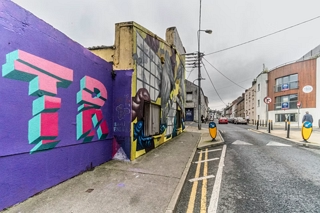
THIS THE ORIGINAL 2016 MURAL BY VUNIK WAS OVER PAINTED IN 2019 BY TAQUEN
The Ephemeral Canvas: Tracing the Evolution of 15 Thomas Street in Waterford City
Documenting urban art across Ireland requires capturing works before weather, masonry failure, or festival turnover erases them forever. A clear case study of this lifecycle is the gable wall at 15 Thomas Street (at the junction of Barker Street and Meeting House Lane) in Waterford City, recorded here across two separate festival iterations.
The 2016 Artwork: Vunik (Serbia) and ESTR (Ireland)
Photographed here in August 2017, the original mural was actually painted a year earlier during the second edition of the Waterford Walls International Street Art Festival in August 2016:
The Main Gable — Vunik (Belgrade, Serbia):
The monumental avian piece on the upper gable is the work of prominent Serbian street and graffiti artist Vunik (Nikola Jovanović).
Known internationally for juxtaposing geometric draughtsmanship with bio-mechanical wildlife, Vunik’s piece features two stylised, stone-hewn grey birds perched upon a fractured wooden limb.
The bird on the right grips a blue stylus or cable in its beak, reaching across the void toward its counterpart.
Behind them, Vunik laid down an architectural drafting grid against a soft yellow wash, framed at the base by heavy, tubular cloud formations in deep violet, indigo, and teal.
The Car Park Entrance Wall — ESTR (Dublin, Ireland):
Flanking the car park opening to the left, the low boundary wall was painted by Dublin-based street artist and muralist Emmalene Blake, painting under her graffiti tag ESTR.
Rendered in vibrant 3D isometric block lettering with teal faces and pink drop-extrusion over a purple ground, the work spells out her moniker across the architectural break: "E" on the left pier, and "STR" on the right.
Canvas Conditions: Ancient Fabric, Porous Render, and Atlantic Weather
Waterford, founded by Norse settlers in 914 AD, is Ireland’s oldest city. While its medieval lanes and Georgian facades offer exceptional streetscapes, the city presents acute structural challenges that frequently caught visiting international artists off guard during the early festival years:
Unfamiliar Substrates: Many visiting artists from continental Europe and North America arrived accustomed to painting on dry-cured modern concrete or smooth, sealed masonry. In Waterford, canvases often consist of 19th-century rubble stone and uninsulated brick gables finished with coarse, sandy lime-and-cement render.
Moisture Ingress and Efflorescence: Situated in a maritime coastal zone, Waterford is subject to high humidity, driving sea mists, and persistent Atlantic rainfall. Older structures generally lack modern damp-proof courses, meaning moisture penetrates deep into the porous wall fabric from both ground level and roof parapets.
The Blistering Mechanism: In the festival's early seasons, before universal moisture-barrier priming became standard practice, artists applied thick layers of modern synthetic aerosol spray paint and exterior acrylic emulsions over unsealed render. The impermeable paint film trapped interior damp inside the wall. As moisture evaporated outward, it pushed dissolved mineral salts (efflorescence) toward the surface. The resulting hydrostatic pressure forced the paint skin to craze, blister, and peel, pulling friable, crumbling chunks of the historic plaster with it.
The Non-Restoration Policy: Why Murals Are Overpainted
When Vunik’s mural began to peel and weather, the festival organisers did not attempt to touch it up or restore it. Instead, Waterford Walls adheres to a deliberate non-restoration policy:
Embracing Ephemerality: Waterford Walls operates under the ethos of graffiti and urban contemporary art, treating the city as an evolving open-air gallery rather than a static outdoor museum. Murals are understood from inception to have a natural lifespan of roughly two to four years before making way for new creative dialogues.
Technical Ineffectiveness of Patchwork: Once an underlying render fails due to moisture saturation, cosmetic surface restoration is futile. New paint applied directly over damp, spalling render will detach within months. The only durable remedy is mechanically stripping back the failing render, filling, and applying a stabilising masonry primer to prepare a sound canvas for a fresh commission.
Managing Finite Wall Space: Prominent, highly visible corner gables in compact city centres are scarce. By rotating deteriorated surfaces rather than dedicating limited festival funding to maintenance, the organisers keep the urban landscape dynamic and guarantee walls for incoming cohorts of domestic and international artists.
The Replacement: Laura by Taquen (August 2019)
In August 2019, Spanish muralist Taquen (based in Madrid) was commissioned to repaint the 15 Thomas Street gable for the festival's fifth edition. Completed on 25 August 2019 first photographed by myself on 26 August 2019, the morning after completion), the new work, titled Laura , introduced a completely different aesthetic:
Artistic Style & Composition: Known for his delicate, organic draughtsmanship, Taquen painted a minimalist, contemplative portrait of a woman seen from behind, her head turned gently in profile with an arm akimbo. Rendered with fine contour lines and a muted palette of earthy terracottas and soft slate greys, the work sat quietly against the soft Irish light.
Architectural Integration: Rather than fighting the building's awkward geometry, Taquen composed around the raking roofline and seamlessly integrated the two barred ground-floor windows into the negative space around the torso.
Mixed-Media 3D Relief: Taquen constructed the subject’s lower forearm and hand using an innovative, raised three-dimensional cardboard applique applied directly to the render. While this organic relief held fast for several seasons, it eventually detached during harsh winter gales in 2021, leaving the underlying painted portrait intact.
Neighbouring Context: Taquen’s mural anchored a major urban art cluster on Thomas Street: British artist Louis Masai’s patchwork elephants continue along the long boundary wall up Barker Street, while the monumental stencil installation by French duo Monkeybird Crew looks on from the adjacent building across the yard.
MURAL BY VUNIK