ALL ABOUT NEW STREET IN WATERFORD
The Tangled Histories of Waterford’s New Street: St John’s Presbytery, Philanthropic Myths, and the Genesis of Waterford Walls
If you spend enough time documenting the Irish urban landscape, you quickly learn that almost every street, vacant plot, and Georgian doorway carries multiple competing histories. In Ireland, local folklore has a habit of folding generations of unrelated memory into a single tidy narrative. When a story sounds suitably benevolent or ancient, it tends to stick—regardless of whether land registry deeds, planning notices, or municipal archives corroborate a word of it.
Waterford’s New Street is a classic study in how these parallel narratives take root.
Today, it is celebrated as the ground-zero crucible for Waterford Walls, now an internationally recognised street art festival. Yet when you dig into the origins of the short-lived New Street Community Garden that started it all, you inevitably collide with a persistent local claim: that the land was donated to the community project by two philanthropic sisters connected to the imposing old house nearby.
The House: St John’s Presbytery
The architectural anchor of the street is an austere, substantial 18th-century residence known locally as St John’s Presbytery (or the Parochial House). Constructed around 1765 as an ambitious multi-bay townhouse for a wealthy Waterford merchant family, it reflects the height of the city’s Georgian maritime prosperity before passing into ecclesiastical hands to serve the clergy of St John’s Parish for generations.
The legend of the "two charitable sisters" who supposedly bequeathed the house, its grounds, or the adjacent vacant space for the common good draws from real, albeit tangled, historical threads. This quarter of Waterford was steeped in 18th- and 19th-century religious charity; Edmund Rice famously set up his first rudimentary school in a converted stable on New Street in 1802, working alongside the early Presentation Sisters. Waterford’s municipal history is also rich with accounts of wealthy benefactresses establishing Catholic almshouses, orphanages, and educational trusts.
Over the decades, as the presbytery fell vacant and the adjacent plots went wild with brambles, local oral memory did what it so often does: it fused the memory of historic female philanthropy with the sudden reappearance of a community project on the same street.
The Reality: Celtic Tiger Ruins and "Meanwhile Use"
The true genesis of the New Street Community Garden was far more contemporary, gritty, and bureaucratic.
During the mid-2000s boom, a terrace of domestic and commercial properties on New Street was snapped up by private speculative developers intending to assemble a prime inner-city retail footprint. When the crash hit in 2008, the scheme collapsed. The houses were abandoned, fell into dangerous structural neglect, attracted severe anti-social issues, and were eventually leveled by the local authority.
What remained was not a family estate donated out of piety, but a derelict, gravel-and-weed brownfield site stranded behind corrugated hoarding and tall boundary walls.
In 2014, local teacher Edel Tobin resolved to rescue the blight. There was no historic land donation. Instead, her voluntary committee navigated the pragmatics of securing a temporary "meanwhile-use" lease from the commercial receivers and financial entities holding the distressed assets, with backing from the city council.
The New Street Community Garden was assembled entirely out of community sweat, crowdfunding, and salvaged material: painted shipping pallets, industrial cable reels for tables, raised timber beds, and volunteer labour.
The Spark for Waterford Walls
To soften the stark, towering masonry gables enclosing the garden, Tobin and curator Louise Flynn invited street artists to paint the perimeter walls.
The visual contrast between raw street art and green volunteer space was an immediate success. The response to those first experimental murals proved that large-scale contemporary art could act as an engine of urban renewal rather than mere decoration. By 2015, that single community experiment expanded across the city, formally launching the inaugural Waterford Walls festival.
Though the community garden eventually closed its gates as temporary leases expired and broader redevelopment plans shifted, New Street remains an open-air archive. At both approaches to the street, weathered original pieces, textured layers of spray paint, and foundational large-scale works still animate the surviving gables—a physical reminder of the grassroots spark that altered Waterford’s visual identity.
Irish streetscapes rarely give you a straight answer. St John’s Presbytery stands as a monument to merchant wealth and church administration; the folklore of the two sisters endures in local conversation; and the murals that changed Waterford were born not from an ancient bequest, but from modern citizens reclaiming a derelict post-crash ruin.
Key Works & Mural Archive
Ador — The Cloud (2017)
The piece depicts his characteristic long-nosed, wide-eyed satirical creature reclining on a cloud across the blue-grey rendered gable, working around the security-grilled window apertures.
To the right, through the open gateway into the garden footprint, is the portrait mural painted by Louise McKenna.
Fintan Magee — Apple Market Gable (2014)
A large gable mural depicting the artist spraying paint onto the wall. It stands as one of the landmark pieces created during the inaugural Waterford Walls street art festival.
Nearby context: The ostrich piece visible further down the street on the green facade of The Woodman pub is by Louis Masai.
Louise McKenna & DMC — Security Gate Collaboration (2017)
The Collaboration: Features portraiture work by Irish figurative artist Louise McKenna (realistic, greyscale/tinted portrait studies set at the left and right) integrated with lettering and graphic street styles by graffiti artist DMC.
Site Context: Painted across the corrugated security gates leading into the New Street site. Because these gates secured the entrance to the New Street Garden footprint, the festival intentionally treated the entire threshold—both Ador’s gable wall and the gate structure—as curated canvas space for the 2017 trail.
Kashink (attrib.) — Commercial Return & Workshop
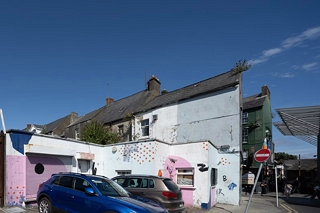
Style & Features: Uses vibrant pastel pinks, deep cobalt blues, geometric shapes, and repeating dotted cluster patterns in a bold, Memphis-inspired pop aesthetic that wraps corners, window frames, and roller shutters.
Street Context: Located adjacent to Fintan Magee's tall gable piece facing the Apple Market. Treating lower-level utility structures and workshops in this playful fashion has been central to brightening neglected service laneways and mews yards off New Street and John Street.
NEW STREET 2026