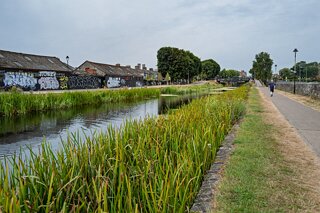
I WALKED FROM BINNS BRIDGE TO CROSS GUNNS BRIDGE I USUALLY WALK IN OPPOSITE DIRECTION
ALONG THE CYCLE AND PEDESTRIAN PATH FROM BINNS BRIDGE TO CROSS GUNS BRIDGE [DORSET STREET TO PHIBSBOROUGH ROAD]
The stretch of the Royal Canal between Dorset Street (Binns Bridge) and Cross Guns Bridge (Phibsborough Road) in Dublin has undergone a remarkable transformation in recent years, evolving from a narrow, uneven towpath into a world-class urban greenway corridor.
1. Upgrades to the Footpath and Cycle Path
Historically, this section of the canal towpath was composed of gravel, compact dirt, and narrow paved sections, bounded by stone canal walls and railway lines. It catered mainly to local pedestrians and anglers, with limited accessibility, restricted lighting, and difficult pinch-points under narrow bridges.
As part of the Royal Canal Greenway initiative—specifically Phase 3 delivered by Dublin City Council in partnership with Waterways Ireland and the National Transport Authority—the section between Spencer Dock and Phibsborough underwent a complete overhaul:
Segregated Mobility: The upgrade introduced wide, high-grade tarmacadam surface paths with dedicated space for pedestrians and cyclists to safely coexist.
Safety & Accessibility: Installation of bat-sensitive LED lighting, ramps, public seating, decorative railings, and improved ramp alignments under historic bridges.
Urban Integration: The path forms a vital arterial link in the national active travel network, connecting the Dublin Docklands directly to North Dublin communities and beyond to the 146 km Royal Canal Greenway route to the Shannon.
2. The Canal Locks: Locks 3, 4, and 5
The Royal Canal rises steeply out of sea level at the River Liffey as it heads westwards toward Phibsborough. To manage this sharp elevation gain across a short distance, a series of closely spaced locks was engineered:
[Binns Bridge / Dorset St] ---> Lock 3 & 4 (Double Lock) ---> Lock 5 [Cross Guns Bridge]
Lock 3 and Lock 4 (The Double Lock): Located along the stretch between Russell Street / Binns Bridge and Dakota Court, Lock 3 and Lock 4 form a classic double lock (often referred to as a staircase lock). In a double lock layout, the top gate of the lower lock chamber (Lock 3) serves as the bottom gate of the upper lock chamber (Lock 4). This design saved both space and masonry during 18th-century construction by eliminating an intermediate canal basin between the two chambers.
Lock 5 (Westmoreland Lock): Positioned immediately adjacent to Cross Guns Bridge on Phibsborough Road. Its foundation stone was laid in 1790 by John Fane, 10th Earl of Westmoreland (then Lord Lieutenant of Ireland). The lock and bridge remain key industrial heritage landmarks of Phibsborough.
3. Why the Path is Closed (3 to 8 August 2026)
The temporary public closure between Dorset Street/Lock 4 and Cross Guns Bridge from 3 to 8 August 2026 is managed under statutory notices issued by Waterways Ireland and Dublin City Council. The primary reasons for this targeted temporary closure include:
BusConnects Infrastructure & Ground Investigation Works: Site investigation, soil testing, and preparatory structural works for the upcoming pedestrian/cyclist overbridge associated with the BusConnects Ballymun/Finglas to City Centre Core Bus Corridor project.
Masonry & Bridge Maintenance: routine inspection and conservation maintenance on the historic stone canal walls, lock gates, and bridge abutments along Lock 4 and Cross Guns Bridge.
Public Safety: Due to restricted width along the canal cut, heavy machinery and engineering teams require a full path closure to carry out work safely without exposing pedestrians or cyclists to hazards.
A signposted pedestrian and cycle diversion is operational via Phibsborough Road and Dorset Street for the duration of the works.
The stretch of the Royal Canal between Dorset Street (Binns Bridge) and Cross Guns Bridge (Phibsborough Road) in Dublin has undergone a remarkable transformation in recent years, evolving from a narrow, uneven towpath into a world-class urban greenway corridor.
1. Upgrades to the Footpath and Cycle Path
Historically, this section of the canal towpath was composed of gravel, compact dirt, and narrow paved sections, bounded by stone canal walls and railway lines. It catered mainly to local pedestrians and anglers, with limited accessibility, restricted lighting, and difficult pinch-points under narrow bridges.
As part of the Royal Canal Greenway initiative—specifically Phase 3 delivered by Dublin City Council in partnership with Waterways Ireland and the National Transport Authority—the section between Spencer Dock and Phibsborough underwent a complete overhaul:
Segregated Mobility: The upgrade introduced wide, high-grade tarmacadam surface paths with dedicated space for pedestrians and cyclists to safely coexist.
Safety & Accessibility: Installation of bat-sensitive LED lighting, ramps, public seating, decorative railings, and improved ramp alignments under historic bridges.
Urban Integration: The path forms a vital arterial link in the national active travel network, connecting the Dublin Docklands directly to North Dublin communities and beyond to the 146 km Royal Canal Greenway route to the Shannon.
2. The Canal Locks: Locks 3, 4, and 5
The Royal Canal rises steeply out of sea level at the River Liffey as it heads westwards toward Phibsborough. To manage this sharp elevation gain across a short distance, a series of closely spaced locks was engineered:
[Binns Bridge / Dorset St] ---> Lock 3 & 4 (Double Lock) ---> Lock 5 [Cross Guns Bridge]
Lock 3 and Lock 4 (The Double Lock): Located along the stretch between Russell Street / Binns Bridge and Dakota Court, Lock 3 and Lock 4 form a classic double lock (often referred to as a staircase lock). In a double lock layout, the top gate of the lower lock chamber (Lock 3) serves as the bottom gate of the upper lock chamber (Lock 4). This design saved both space and masonry during 18th-century construction by eliminating an intermediate canal basin between the two chambers.
Lock 5 (Westmoreland Lock): Positioned immediately adjacent to Cross Guns Bridge on Phibsborough Road. Its foundation stone was laid in 1790 by John Fane, 10th Earl of Westmoreland (then Lord Lieutenant of Ireland). The lock and bridge remain key industrial heritage landmarks of Phibsborough.
3. Why the Path is Closed (3 to 8 August 2026)
The temporary public closure between Dorset Street/Lock 4 and Cross Guns Bridge from 3 to 8 August 2026 is managed under statutory notices issued by Waterways Ireland and Dublin City Council. The primary reasons for this targeted temporary closure include:
BusConnects Infrastructure & Ground Investigation Works: Site investigation, soil testing, and preparatory structural works for the upcoming pedestrian/cyclist overbridge associated with the BusConnects Ballymun/Finglas to City Centre Core Bus Corridor project.
Masonry & Bridge Maintenance: routine inspection and conservation maintenance on the historic stone canal walls, lock gates, and bridge abutments along Lock 4 and Cross Guns Bridge.
Public Safety: Due to restricted width along the canal cut, heavy machinery and engineering teams require a full path closure to carry out work safely without exposing pedestrians or cyclists to hazards.
A signposted pedestrian and cycle diversion is operational via Phibsborough Road and Dorset Street for the duration of the works.
BINNS BRIDGE TO CROSS GUNS BRIDGE