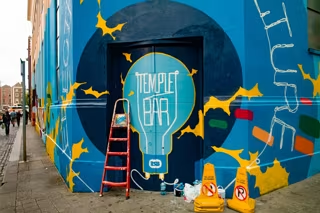
THIS WAS A WORK IN PROGRESS WHEN I PHOTOGRAPHED IT IN 2012
Photographed Not Later That 4 April 2012
I used a Sigma Dp1 and the internal clock reset every time I changed the battery and the images are incorrectly dated 9 Feb 2009 when in fact the mural was created in 2012
The Mural and the Artist
The artwork captured in these images is titled Urban Expression, painted by prominent Dublin artist and graphic designer James Earley (frequently working under his studio moniker Inputout).
The Canvas & Location: The site is the ESB 38kV Substation located at the corner of Bedford Row and Fleet Street in Dublin’s Temple Bar. Originally designed in 1926 by architect Vincent Kelly, this austere International Modernist brick-and-render structure had long presented a blank, utilitarian industrial exterior in the heart of Dublin's cultural quarter.
Historical Significance: This work was indeed the first major large-scale sanctioned mural across the substation’s facade. It established the building as a rotating civic canvas for urban art, paving the way for later monumental works such as SUBSET's Climate III ("Fish in a Bag") in 2019 and subsequent commissions.
Style & Composition: The mural marks Earley’s transitional period between pure street graffiti/lettering and the distinct, celebrated style that defines his later career. Coming from a family renowned for ecclesiastical stained glass spanning generations (the historic Earley Studios of Camden Street), Earley translated traditional leaded outlines and radiant panes of colour into bold aerosol and exterior emulsion. The composition blends flowing liquid motifs, dynamic ribbons, botanical and fruit forms, and bold typographic elements—including the glowing "Temple Bar" electric bulb framed around the substation's metal doorway, nodding to the ESB's functional role.
The Date Discrepancy: The recorded EXIF date of 9 February 2009 is incorrect due to the Sigma DP1’s battery clock reset. The installation and painting of Urban Expression took place in 2012 (active during the summer and autumn of 2012), coinciding with the early development and expansion of the adjacent Icon Walk network around Bedford Lane. The ladder, open paint tins, and warning cones at the corner doorway confirm this photograph captured the piece actively in progress.
THE FIRST LARGE MURAL