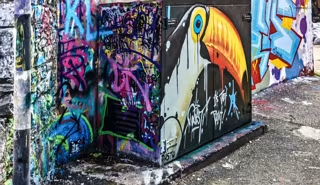
PHOTOGRAPHED USING A SONY VG10E CAMCORDER
THIS STREET ART NO LONGER EXISTS AS THE CROSSE'S GREEN AREA IN CORK HAS BEEN REDEVELOPED
Crosse’s Green: Historical Context and Urban Roots
Crosse’s Green occupies an intriguing position on the south channel of the River Lee, situated immediately west of Cork’s historic medieval core and South Gate Bridge. In the Middle Ages, the area formed an islet known as Sancta Maria de Insula (St Mary of the Isle), home to a prominent Dominican friary founded in 1229. Over following centuries, as marshlands were reclaimed and the medieval walls became obsolete, the locality developed into a busy industrial and trading hub.
By the eighteenth and nineteenth centuries, Crosse’s Green and its neighbouring quays accommodated extensive milling operations, timber yards, cooperages, and river-borne freight networks. An archway from Proby’s Bridge still endures nearby, reminding passers-by of the tidal mill-races that once powered South Parish trade. Archaeological investigations during later developments uncovered hundreds of medieval burials and friary foundations beneath what had long functioned as industrial yards, workshops, and transit depots.
Modern Transformation: Redevelopment and New Footbridges
Throughout the late twentieth and early twenty-first centuries, portions of Crosse’s Green transitioned from semi-derelict light industrial pockets into student housing, apartment developments, and car parks. The immediate riverfront corridor, however, has undergone a fundamental transformation linked directly to the broader regeneration of the old Beamish & Crawford brewery site (the Grand Parade Quarter).
As part of these public realm and infrastructure schemes, two significant pedestrian and cycle bridges were commissioned across the River Lee’s south channel:
Crosse’s Green Bridge: Spanning between Crosse’s Green and the historic Counting House plaza on the Beamish & Crawford site.
Lamley’s Lane Bridge: Providing a western pedestrian link connecting nearby Lamley’s Lane to Wandesford Quay.
These modern spans are designed to integrate the South Parish directly with the city centre, replacing forgotten alleyways, loading docks, and low perimeter yard walls with permeable boardwalks, plazas, and flood-alleviation embankments. In opening the quay to continuous footfall and contemporary architecture, the transitional, industrial-era masonry walls that formerly acted as ad-hoc canvases were swept away.
The Evolution of Irish Street Art: From Raw Graffiti to Curated Murals
The photograph captured in 2019 documents an ephemeral phase of Irish urban subculture: the organic, unsanctioned wall. In places like Cork, Dublin, and Limerick, blank yard walls, hoarding around stalled construction sites, and derelict industrial units long functioned as informal "halls of fame" for writers and street artists. These spaces hosted layered, competitive typography (as seen in the "PEAKE" piece and adjacent throw-ups), constantly buffed, repainted, and evolving without official oversight.
Over the past decade, urban landscapes across Ireland have witnessed a marked structural shift:
Taming the Canvas: As urban regeneration accelerates and vacant sites are filled, raw surfaces disappear. In their place, local authorities and business improvement districts have adopted muralism as a key instrument of placemaking, tourism, and anti-vandalism management.
Sanctioned Initiatives: Projects such as Cork’s Ardú Street Art Project, Dublin’s curated public art commissions, and the Mad About Cork utility box interventions have systematically replaced unsanctioned walls with structured, funded public art.
Thematic and Commercial Shift: While this formalisation provides local and international artists with legitimate income, access to cherry pickers, and large multi-storey gables, it fundamentally changes the nature of the art form. Gritty, self-directed lettering and counter-cultural tagging are largely supplanted by illustrative portraiture, heritage motifs (such as historical figures or native flora and fauna), and brand-aligned corporate commissions designed for civic appeal and social media consumption.
The photograph of Crosse’s Green serves as a visual record of an interim moment: an authentic collision of 19th-century industrial fabric, spontaneous modern spray work, and the calm before large-scale civic regeneration transformed the quay.
CROSSES GREEN AREA OF CORK